Obsidian Second Brain with Claude for a New York Times bestselling author
A New York Times bestselling author thought she had a few notes for Obsidian. They came to more than 18 GB, sixteen years across Bear, Evernote and Notion. I sorted every file by whose words it holds and linked notes only where there was a reason, so her own words can grow into new work.
- Client
- A New York Times bestselling author
- Sector
- Publishing
- Scope
- Knowledge ManagementData MigrationInformation ArchitectureAI Automation
- Technologies
- ObsidianClaude Cowork
- Models
- Claude Fable 5.1
Background
Her essay collection The Collected Schizophrenias was a New York Times bestseller, it followed her novel The Border of Paradise, and Granta has named her one of the best young American novelists. She also writes Reasons for Living, her newsletter on Substack.
Her request came in late on a Friday night with no brief and no files, so all I knew was that she wanted help with her notes. We spoke that same night. She made it sound small, a bunch of notes, mostly in Bear with others here and there, and she wanted them in Obsidian. I told her Bear and Obsidian are only ways of reading the same Markdown files, and that what matters is the files and how they're organised. Obsidian was a good home for them, so that's where they went.
When the first files came, I went through them and drew her a plan for the vault, folder by folder. She corrected one thing, since Reasons for Living is her newsletter and not a book. Then she told me the bigger thing. Organising was the smaller part. What she wanted was somewhere for her own words, the jotted thoughts and fuller paragraphs mixed in among everything she'd saved from other writers, so she could ask how many notes she had on one subject and what they said, and let a single thought grow into a book, a memoir or an issue of her newsletter. Her next book, already under contract, was the first place she wanted it to work.
The problem: more than 18 GB
The files she'd sent weren't all of it. Notion's export had left out every page nested inside another, so links all through her Notion pages pointed at nothing. I asked her to export it again with its subpages, and the full set came to more than 18 GB, sixteen years of notes from Bear, Evernote and Notion, in Markdown, PDFs, plain text, HTML and whole Notion pages. The download failed again and again before it came through, and with that much more to go on I ran the whole analysis again, because it could change the plan.
None of it could simply be copied across. Bear's IDs looked like ordinary timestamps but put the day before the month, so a normal import would have quietly moved her notes to the wrong dates. Bear's titles were whole sentences, long enough to break Windows. A folder of macOS leftovers sat beside everything, doubling any count that didn't know to skip it. Her private material was mixed in with all the rest.
What the exports hid
What I built
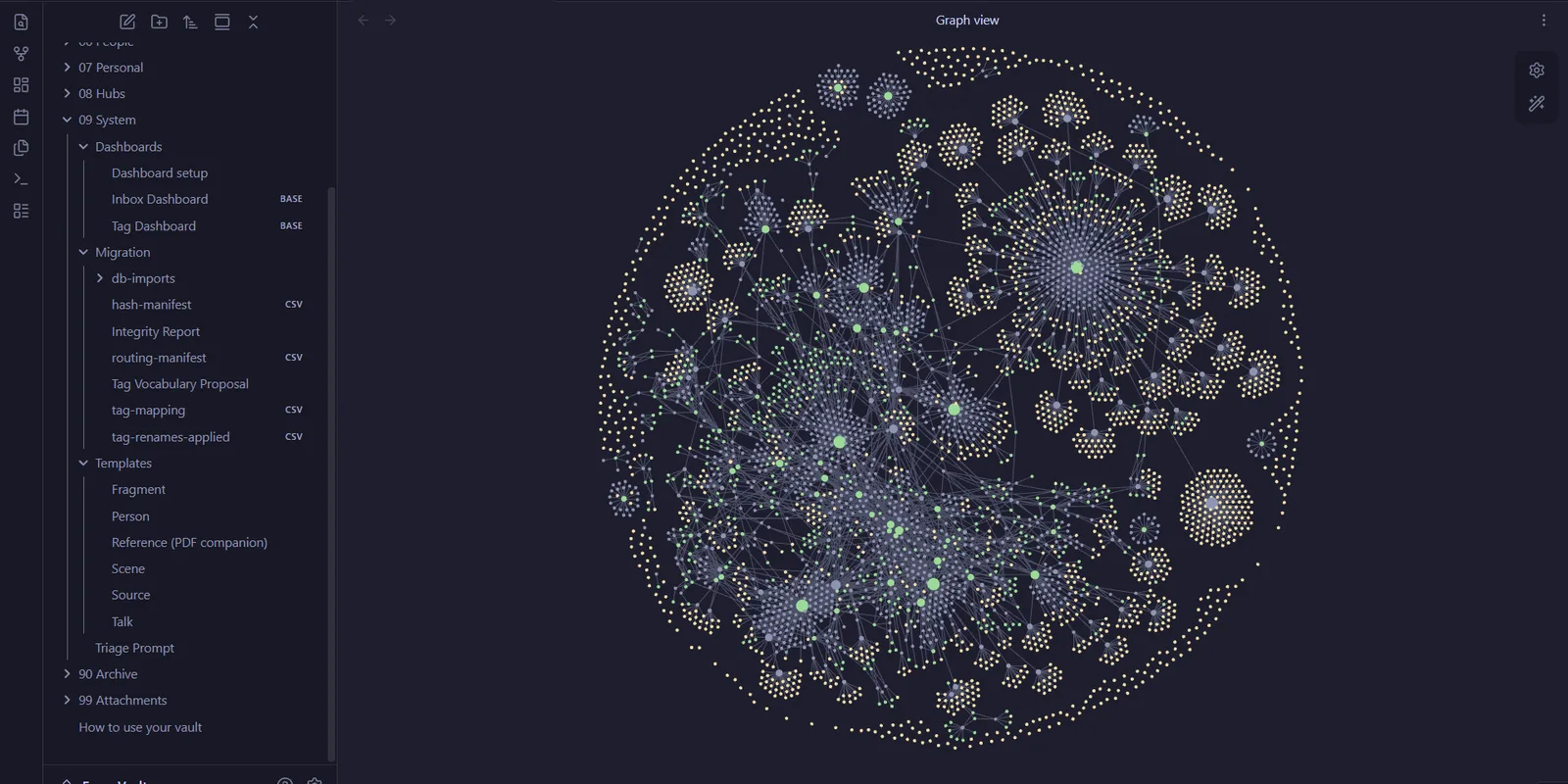
I built the vault around two questions whose answers never change, whose words a note holds and what stage it's at. Her own work sits at the top, her books and a Notebook for thoughts not yet tied to a project, and other people's words go into an archive underneath that only ever grows. Topics live in tags instead of folders, because a note can be about five things but can only sit in one folder. Her private material sits behind a single folder, so one rule keeps it out of any sync.
She asked for links that made sense, not links for their own sake, and for her files to stay as they were. So no link was made without a reason that fits in one sentence, and none was written into her notes. They live in hub notes, one per subject, each listing its notes with the reason beside them, and Obsidian's backlinks show the hub inside every note it names. Apart from a block of properties at the top of each note, not a word she wrote was changed, and every original was fingerprinted before the work began.
New notes go into an Inbox, and sorting them takes one prompt. She gives Claude Cowork the vault and the triage prompt I wrote for it, and it shows her a table of every file, where it would go and why, and moves nothing until she approves. When it can't tell whether she wrote something or saved it, it asks her, and each answer becomes a standing rule, so it asks less each time.
How the vault runs
The result
I handed her the vault with a guide, How to use your vault, written for her and for whichever AI she points at it. That night she wrote back,
Hurrah! It works!
By the handoff call she had it running on her phone and her desktop, in colours and fonts of her own, with folders she'd added herself. I walked her through it, and then she ran her first prompt on her own vault. It tidied the titles in her Notebook in seconds and left the text under every one of them as it was. A writer who thought she had a few notes has sixteen years of them in one place, sorted by whose words they are, where her own can grow into her next book.
What a champ. He made a second brain for me in Obsidian after I threw thousands of files at his head and it came out beautifully.
saif@silverthreadlabs.com