What Actually Happened to Jensen Huang, and Who's Behind It
On this page
Jensen Huang built Nvidia in 33 years, and they erased him in 4 days. He resigned as its CEO on 11 November 2026, three days after admitting an affair, before the investigators his own board had hired reported anything. I believe he was pushed out because his influence got too big for the people used to running things, and this is the story as I see it.
From a Denny's booth to the top of the world#
He came to America at nine, sent to a boarding school in Kentucky. At fifteen he was washing dishes at a Denny's in Portland. In 1993 he sat in a Denny's booth with Chris Malachowsky and Curtis Priem and planned a graphics chip company, and in the mid-1990s it nearly went bankrupt. He says he has run it ever since as if it were "30 days from going out of business".
He ran it for 33 years. A whole generation grew up gaming on his GeForce cards, and then the AI boom ran on his chips. In May, at Carnegie Mellon, he called Nvidia "the body of work I share with 45,000 extraordinary colleagues" and "my life's work".
What happened in four days#
- 29 October. The New York Times reports that US intelligence believes Alice Huang, a Chinese businesswoman close to him, was gathering information for Beijing.
- 30 October. China's foreign ministry calls the report "groundless speculation" and "nothing more than an attempt to smear China". Singapore's Ministry of Home Affairs says "there were no such investigations conducted in respect of" her.
- Sunday 8 November. Huang tells his staff he was unfaithful to his wife.
- Tuesday 10 November. The independent directors hire a former federal prosecutor and the law firm Wachtell to investigate.
- Wednesday 11 November. The Times reports a second affair, the Wall Street Journal reports the board is "preparing to oust" him, and the board accepts his resignation that same day.
- Thursday 12 November. Nvidia names its CFO, Colette Kress, interim CEO, and Harvey C. Jones its "first-ever Chair of the Board". Reuters reports a third affair, with another Nvidia employee, from two people familiar with it. Bloomberg reports Alice Huang is living in Beijing. Singapore says it barred her from returning in February over her company's case, and that she "was not investigated for espionage."
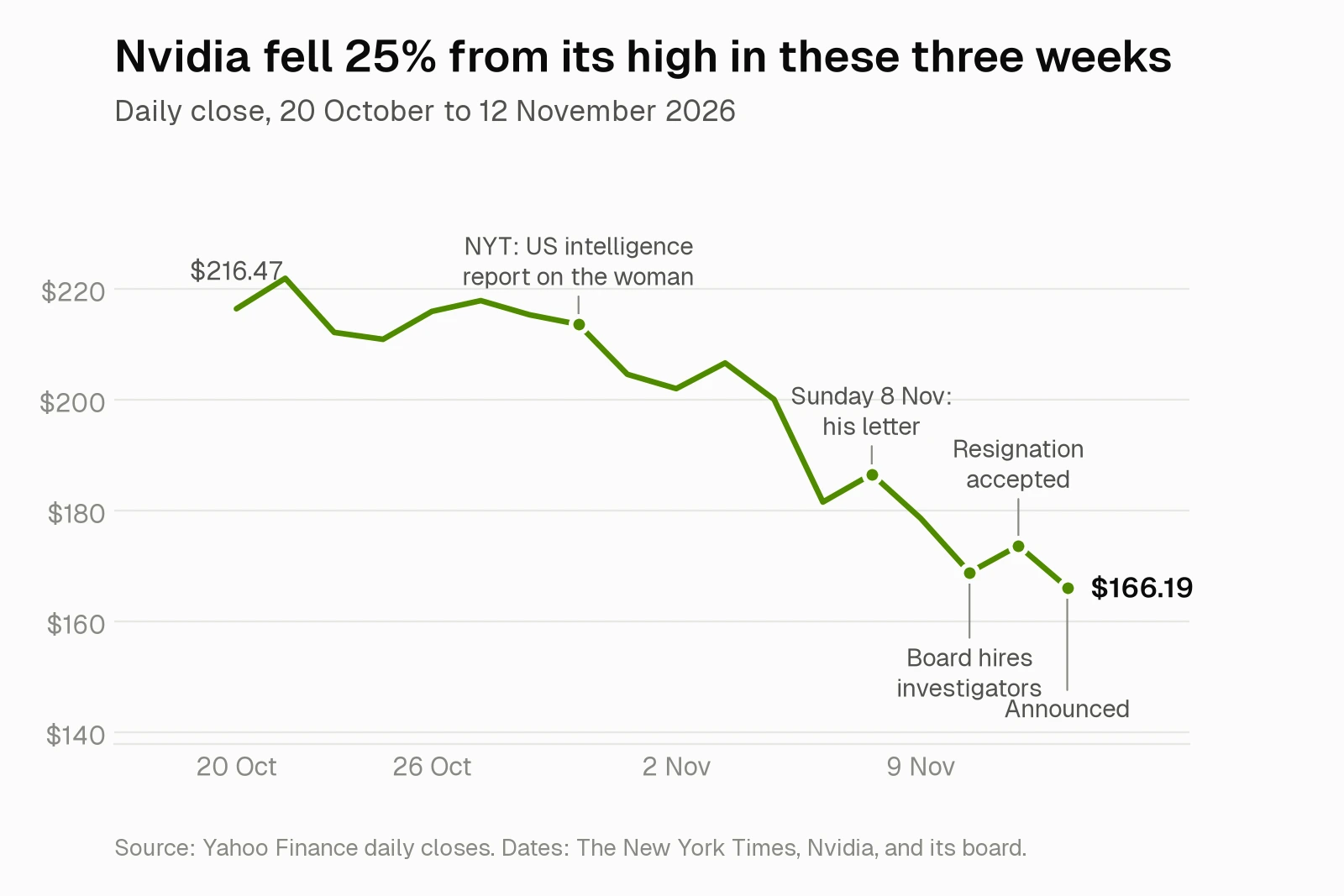
The investigation hadn't published a single finding when he was gone.
Was Alice Huang a Chinese spy?#
Nobody has shown that she was. The Times' story rests on what US intelligence believes, and I haven't found a single piece of that evidence made public. Beijing denied it the day after. Singapore, where she ran her company, says it never investigated her for espionage. And now she's in Beijing, out of reach, so the one person who could settle it never will, and he may never get to fully clear his name.
The affairs were real, and he owned the first one himself. But look at how they came out. A spy story nobody has had to prove, then a second affair, then a third, the last one leaked after he'd already gone. One allegation after another, each landing right when it would hurt most. I don't believe that timing is an accident.
Was Jensen Huang fired?#
On paper he resigned and the board accepted it. But when the Journal is reporting that your board is preparing to oust you, the resignation letter is a formality.
The board that accepted it was nine people besides him, and some had sat beside him for most of his life. Tench Coxe and Harvey C. Jones had been directors since 1993, the year he started the company, and Brooke Seawell since 1997. The day after he left, the board named Jones its first-ever chair. Nvidia had never had one, only a lead director.
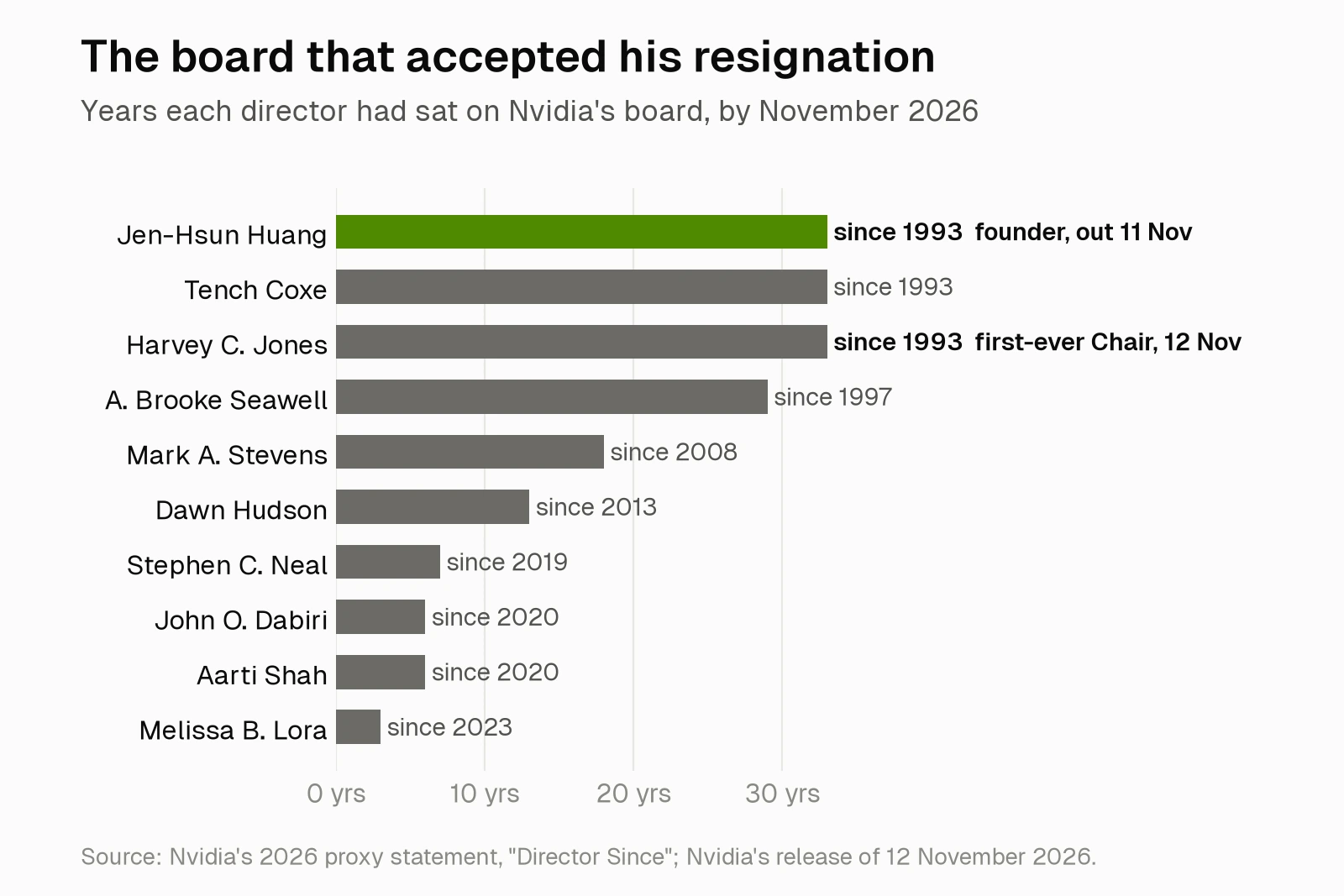
The D3 List, a business podcast, called them "the cowards who fired Jensen Huang" in a reel, and Jones's new title "a power grab by a long term friend".
Who replaced Jensen Huang?#
For now, Colette Kress, Nvidia's CFO since September 2013, who stays CFO while she runs the company as interim CEO until the board finds a permanent one. She answers to Jones as chair, so a company that was one man's vision for 33 years is now run by its finance chief.
Do Nvidia's employees want Jensen Huang back?#
Overwhelmingly. Before he resigned, a longtime engineer posted in Nvidia's internal suggestion box asking the board to weigh what its people thought before doing anything. By 12 November it had more than 1,600 comments, WIRED reported, most of them asking to bring him back. "If you believe in the mission, bring back THE boss," one wrote. Another staffer emailed the whole company, "I stand by Jensen." On Blind, 88% of the Nvidia employees who answered said he should stay CEO, and 1% said the board should remove him.
Outside the headquarters in Santa Clara, people came and left flowers under the sign.
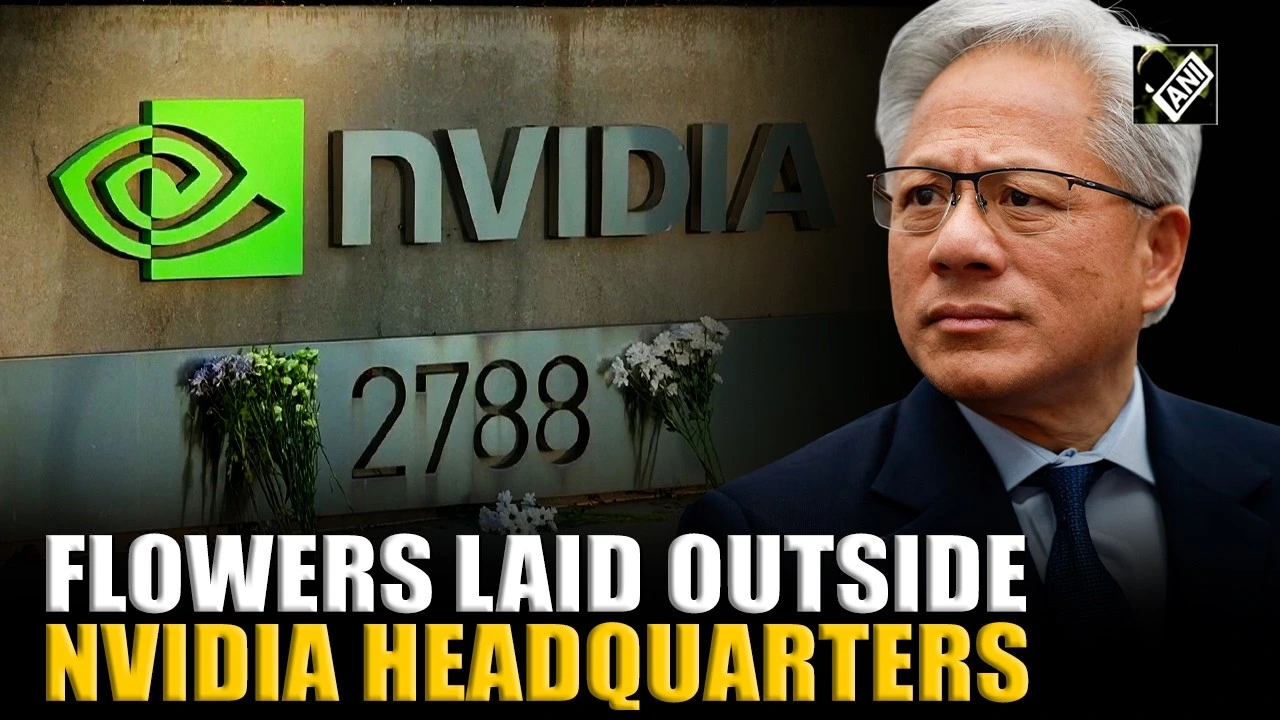 ANI News
How much of Nvidia does Jensen Huang own?#
When Nvidia went public in January 1999 he owned about 13% of it before the offering and about 11% after. By March 2026 it was 3.58%. That's still the largest stake of any individual, but nowhere near control, and Nvidia has a single class of stock with "one vote for each share", so the founder had no extra votes to protect him.
| Holder | Stake in Nvidia, from the 2026 proxy |
|---|---|
| Jensen Huang | 3.58% |
| BlackRock | 7.43% |
| Vanguard Capital Management | 7.31% |
Institutions together hold more than half the company.
He could have held on to far more. Nvidia paid its people in stock, and he let his own share shrink while theirs grew, because he cared about the people building it with him. Nobody can take that from him. It's also what left him with no votes to protect him.
So by the end the founder was the soul of the company and the face of the brand, without the power to keep his own job. His power was the kind that doesn't show up on a cap table. When he spoke, his staff, the industry and millions of people who'd never owned a share listened. The people who hold the votes don't stand on stages, and you can't vote out a man like that on numbers alone. You go after his name.
An affair doesn't usually end a founder#
Jeff Bezos's affair went public on 9 January 2019. Sixty trading days later Amazon's shares were up 10%, and he stayed its CEO until July 2021. Sergey Brin's affair with a Google employee was reported on 28 August 2013, and sixty trading days later Google's shares were up 22%. Brin wasn't the CEO, but he stayed at the company he founded. Huang wrote his letter on 8 November, Nvidia's shares fell 11% in the next four trading days, and he was gone.
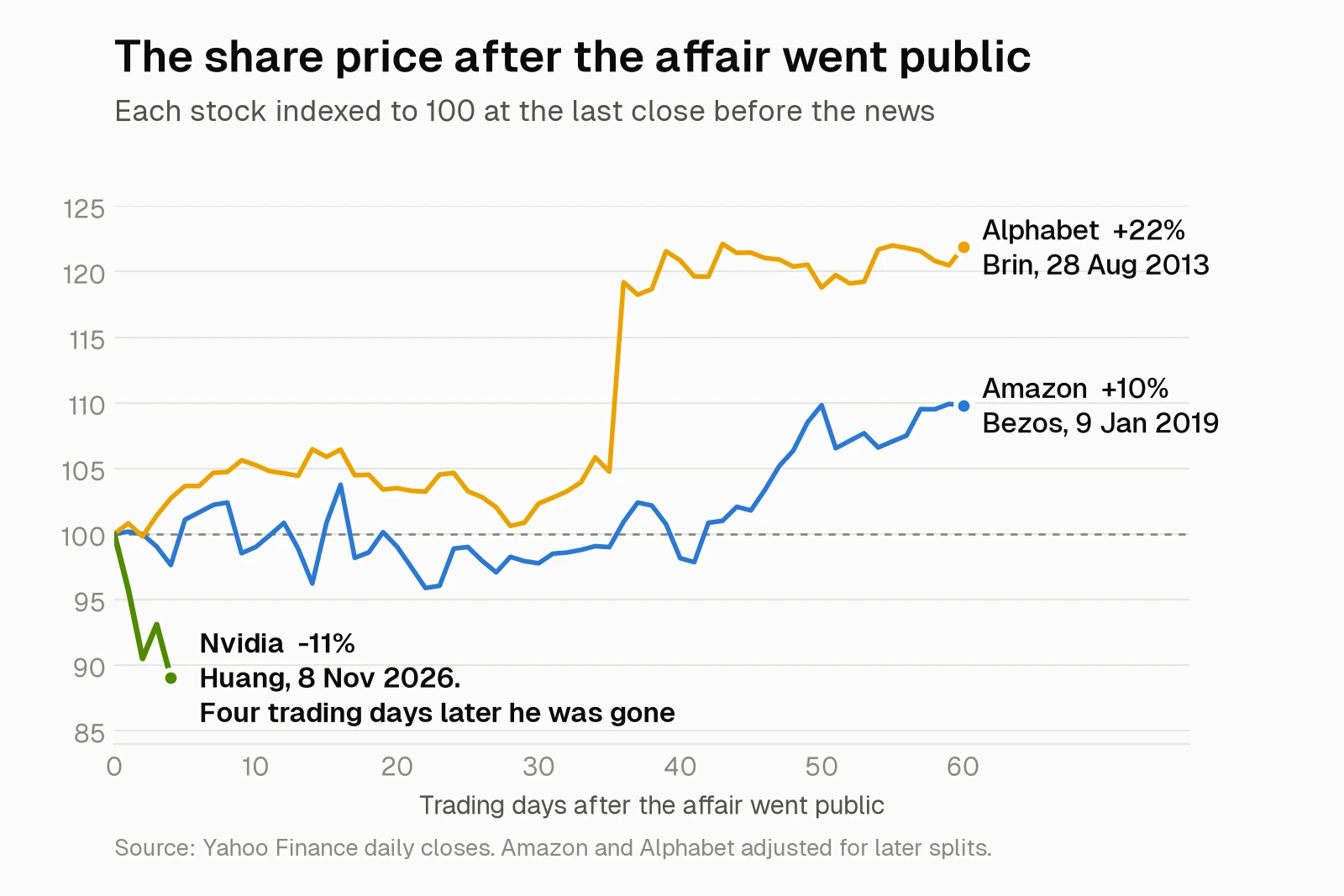
The CEOs who were gone within days were hired managers. Intel's Brian Krzanich in 2018 and McDonald's Steve Easterbrook in 2019 both left over relationships with employees, and neither had founded the company he ran. Huang had built his from a booth.
Who are "they"?#
I'm sure this was manufactured, because his influence had grown too big for the people who are used to giving the orders, and he kept fighting Washington's limits on selling Nvidia's chips to China. People close to this have told me he was pressured, and threatened, to go quietly, and that he fought tooth and nail to stay. I can't show you that, and I won't name anyone. One man can't hold out for long against the people who own the votes.
I don't claim to know who "they" are. Plenty of people online are pointing at someone, though, and their voices deserve a home here.
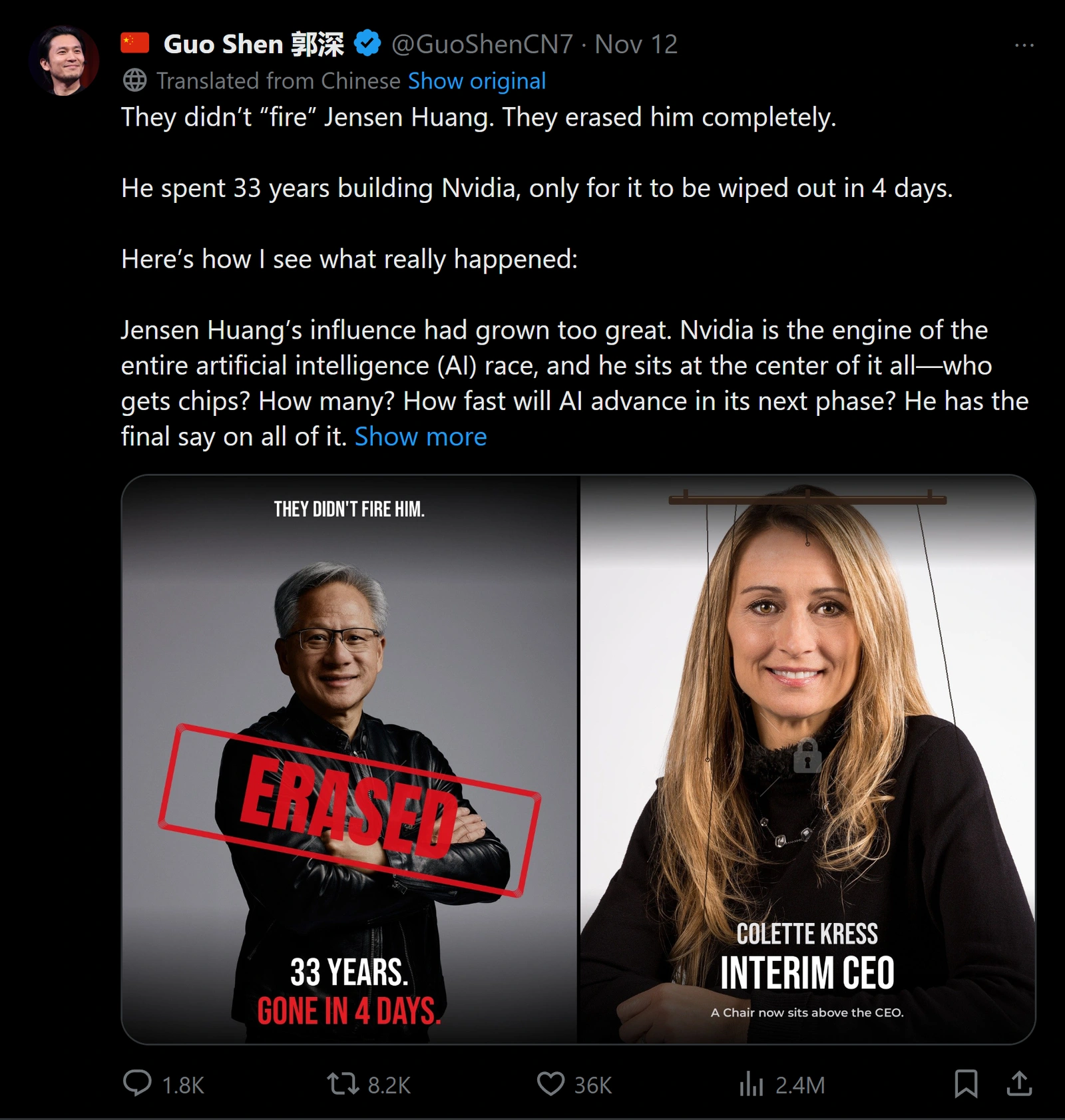
A thread by @GuoShenCN7, seen more than 2.4 million times, argues "They didn't 'fire' Jensen Huang. They erased him completely" (translated from the Chinese). It says he sat at the center of who gets chips, how many and how fast, and that the forces behind him "found that they could no longer control him".
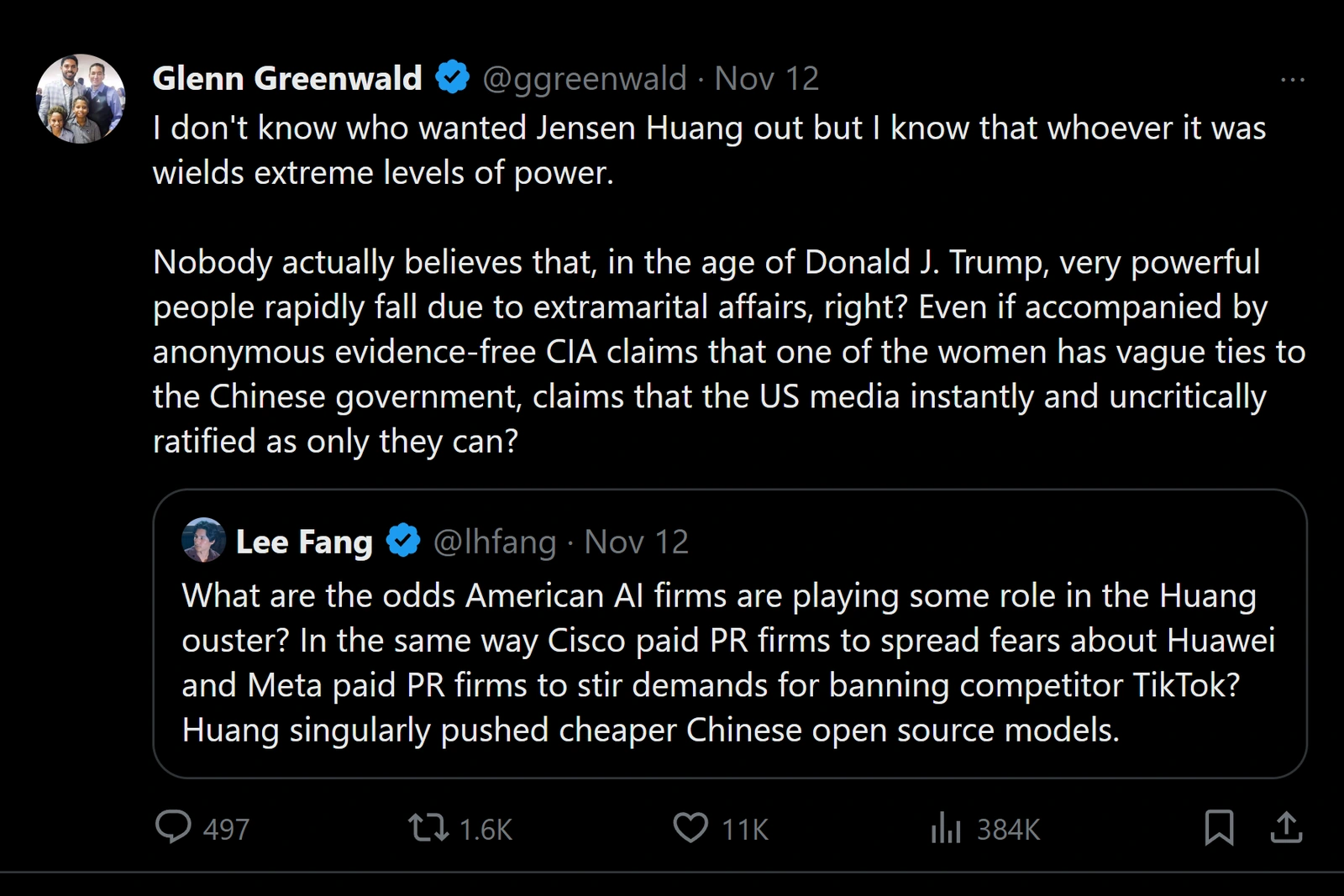
Glenn Greenwald wrote "I don't know who wanted Jensen Huang out but I know that whoever it was wields extreme levels of power." He was quoting the journalist Lee Fang, who asked whether American AI firms had a hand in it, since "Huang singularly pushed cheaper Chinese open source models."
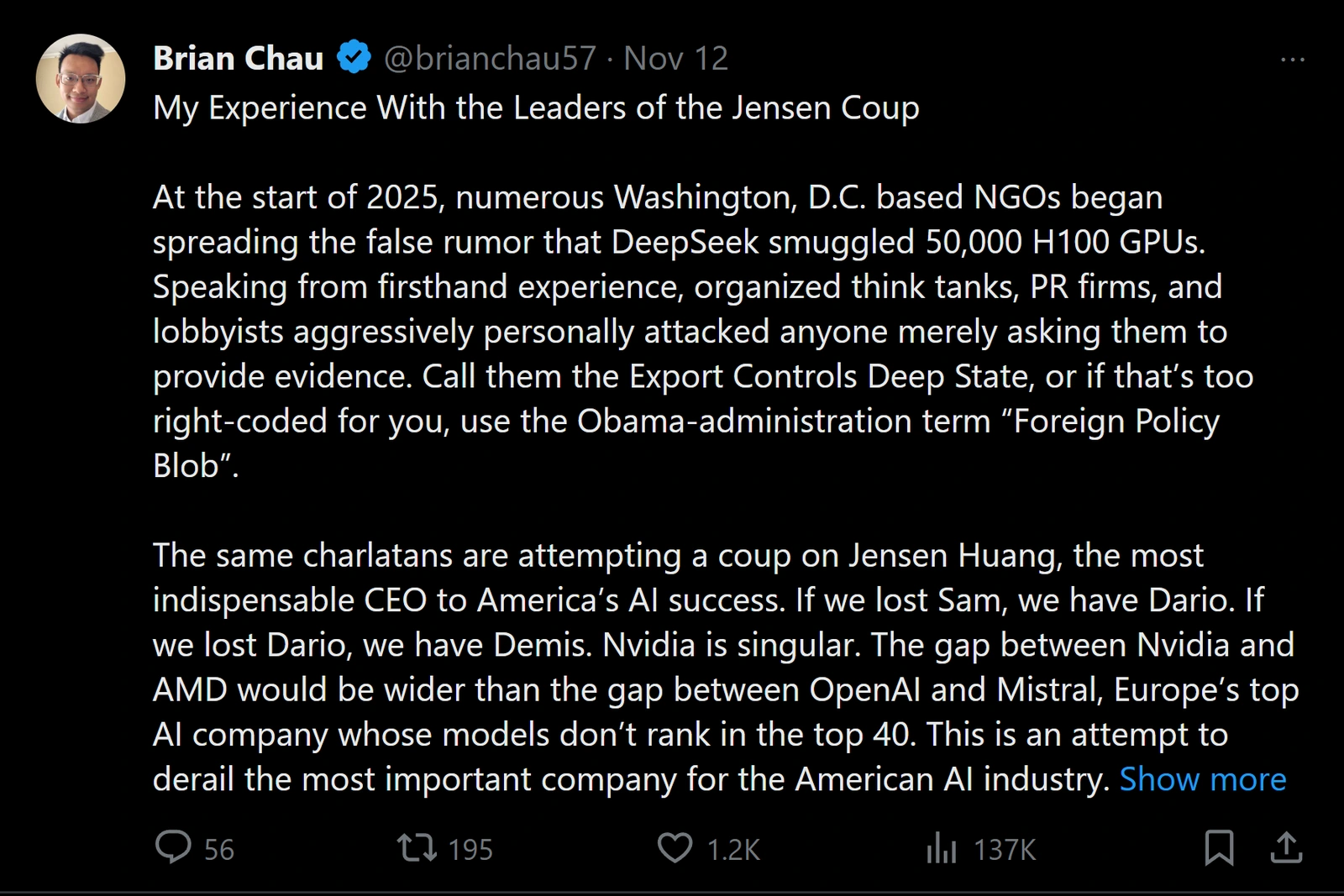
Others called it a "hit job" or "a coup on Jensen Huang". One post seen 1.7 million times said "They timed this hit job perfectly and in earnest."
And Donald Trump, who called Huang "an honorable guy" on 8 November, had a replacement in mind four days later. "A Legend replaces a Legend!" he posted, naming Apple's Tim Cook.
Intelligence for everyone#
History has a pattern with people who try to give the world something for free. Nikola Tesla wanted free energy for everyone, and he was cut off and died broke. Huang wanted intelligence in everyone's hands.
Look at what came out of Nvidia while he was there. Small Chinese labs like DeepSeek, and small teams elsewhere like Black Forest Labs, released open models that shook the whole industry. Nvidia, with the best chips on earth and some of the greatest minds in the field, released Nemotron, and Nemotron was nowhere near them. The company powering all of it could have taken on any frontier lab or any Chinese model if it wanted to. That's no coincidence. I believe he wanted that intelligence shared, and he didn't get the final say.
Insult to injury#
Then the internet piled on. Open your feed this week and it's Jensen Huang everywhere, in memes and in AI-made pictures, videos and reels of him doing things he never did. On the day he resigned, X's own news panel counted 1.8 million posts about it, next to 2,069 for the next biggest story.
Most of it is obvious slop, the kind anyone can spot as fake at a glance. Some of it isn't. A few videos have surfaced that I can't tell from real footage, three to five minutes long, cut together with clips from his real podcasts so he seems to say things he never said.
Videos like that cost real money. The best video models, like ByteDance's Seedance 2.5, are billed by the second, $0.59 a second at 1080p through one gateway, and make at most 30 seconds at a time. Five minutes is ten separate clips and $177 before a single retake, and nobody gets it right on the first take. Meme pages don't spend that on a joke, over and over.
This is memetic warfare, and governments run it. Reuters reported in 2024 that Trump had the CIA start a covert campaign on Chinese social media in 2019 to turn people against Beijing's government. The same year Israel's Ministry of Diaspora Affairs was reported to have paid a firm $2 million for an online campaign aimed at American lawmakers, which its minister denied. My source tells me the videos about Huang are a Mossad campaign to discredit him, millions of them. I can't show you that either, but somebody is paying for them.
The people laughing at him were doing it with tools that exist because of what he built.
Huang says he named the company after invidia, the Latin for envy, and its logo is an eye. Nvidia has never said what the eye means, and some see the one on the dollar bill.
His letter to his staff, the last thing he wrote to them as CEO, said "Leading NVIDIA is the privilege of my life." Whatever you believe about how it ended, nobody gets to erase what he built.
I covered his fall in my shorts all week, and I made the last one my tribute to him, his whole life in a minute and a quarter, ending on his own voice.
Sources#
- Nvidia, "NVIDIA Announces CEO Transition", 12 November 2026, https://nvidianews.nvidia.com/news/nvidia-announces-ceo-transition
- Jensen Huang, "A Message to Our Company", 8 November 2026, https://nvidianews.nvidia.com/news/a-message-to-our-company
- Nvidia's blog, "The $1 Trillion Booth", 26 September 2023, https://blogs.nvidia.com/blog/nvidia-dennys-trillion/
- Oneida Baptist Institute, Huang Hall, https://www.oneidaschool.org/about/huanghall.cfm
- Nvidia's blog, "NVIDIA CEO Tells NTU Grads to Run, Not Walk", 26 May 2023, https://blogs.nvidia.com/blog/2023/05/26/huang-ntu-commencement
- Fortune, Huang on The Joe Rogan Experience, 4 December 2025, https://fortune.com/2025/12/04/nvidia-ceo-admits-he-works-7-days-a-week-including-holidays-in-a-constant-state-of-anxiety-out-of-fear-of-going-bankrupt/
- Carnegie Mellon University, 2026 commencement address by Jensen Huang, 10 May 2026, https://www.youtube.com/watch?v=FZh_0uRgrg4
- BBC via Yahoo, "China denies allegations of spy operation targeting Nvidia CEO", 30 October 2026, https://www.yahoo.com/news/world/articles/china-denies-allegations-spy-operation-122009829.html
- AP via PBS NewsHour, "What we know — and what we don't — as Nvidia investigates an alleged spy plot involving its CEO", 9 November 2026, https://www.pbs.org/newshour/world/what-we-know-and-what-we-dont-as-nvidia-investigates-an-alleged-spy-plot-involving-its-ceo
- Ministry of Home Affairs, Singapore, "Clarification Statement on Wall Street Journal's Article", 30 October 2026, https://www.police.gov.sg/media-hub/news/2026/10/20261030_clarification_statement_on_wall_street_journals_article
- The Wall Street Journal on X, 11 November 2026, https://x.com/WSJ/status/2120648765665120312
- TechCrunch, "Jensen Huang accused of having another affair", 11 November 2026, https://techcrunch.com/2026/11/11/jensen-huang-accused-of-having-another-affair-with-a-nvidia-exec/
- Nvidia's board, "Statement From the Independent Members of the NVIDIA Board", 10 November 2026, https://nvidianews.nvidia.com/news/statement-from-the-independent-members-of-the-nvidia-board
- Ministry of Home Affairs, Singapore, "Singapore's Investigations into Alice Huang (Huang Le) and Megaspeed International Pte Ltd", 12 November 2026, https://www.mha.gov.sg/media-room/newsroom/singapore-investigations-into-alice-huang-huang-le-and-megaspeed-international-pte-ltd/
- The D3 List, "Is Nvidia's board full of snakey people", a reel on Instagram, November 2026
- Reuters via The Korea Times, "Alleged Chinese spy in Nvidia scandal is living in Beijing, Bloomberg News reports", 12 November 2026, https://www.koreatimes.co.kr/world/20261112/alleged-chinese-spy-in-nvidia-scandal-is-living-in-beijing-bloomberg-news-reports
- Reuters via Newsweek, "Jensen Huang Reportedly Had Third Affair; Nvidia Exit Caps Week of Scandal", 12 November 2026, https://www.newsweek.com/jensen-huang-reportedly-had-third-affair-nvidia-exit-caps-week-of-scandal-12708382
- Nvidia's IPO prospectus, S-1/A Amendment No. 7, 20 January 1999, https://www.sec.gov/Archives/edgar/data/1045810/0000898430-99-000180.txt
- Nvidia's 2026 proxy statement, 12 May 2026, https://www.sec.gov/Archives/edgar/data/1045810/000104581026000036/0001045810-26-000036-index.htm
- Nasdaq, NVDA institutional holdings, https://www.nasdaq.com/market-activity/stocks/nvda/institutional-holdings
- NPR, "Jeff Bezos built Amazon 27 years ago. He now steps down as CEO", 5 July 2021, https://www.npr.org/2021/07/05/1013166252/jeff-bezos-built-amazon-27-years-ago-he-now-steps-down-as-ceo-at-critical-time
- Intel, "Intel CEO Brian Krzanich Resigns", 21 June 2018, https://www.intc.com/news-events/press-releases/detail/146/intel-ceo-brian-krzanich-resigns-board-appoints-bob-swan
- NBC News, "McDonald's CEO out over poor judgment in relationship with employee", 3 November 2019, https://www.nbcnews.com/news/us-news/mcdonald-s-ceo-out-over-poor-judgment-relationship-employee-n1075886
- @GuoShenCN7 on X, 12 November 2026, https://x.com/GuoShenCN7/status/2120921814050156997
- Glenn Greenwald on X, 12 November 2026, https://x.com/ggreenwald/status/2120889241957773636
- Lee Fang on X, 12 November 2026, https://x.com/lhfang/status/2120887714065297706
- @aravind on X, https://x.com/aravind/status/2119673345927233653
- @brianchau57 on X, 11 November 2026, https://x.com/brianchau57/status/2120745928722087948
- Reuters via The Star, "Trump calls Nvidia's Huang 'honorable'", 9 November 2026, https://www.thestar.com.my/tech/tech-news/2026/11/09/trump-calls-nvidia039s-huang-039honorable039-says-he-has-not-discussed-allegations-with-him
- Donald Trump on Truth Social, 12 November 2026, https://truthsocial.com/@realDonaldTrump/117604177898784579
- WIRED, Paresh Dave and Zoë Schiffer, "'Bring Back THE Boss': Nvidia Employees Petition for Jensen Huang's Return", 12 November 2026
- Blind, "60% of Professionals Say Jensen Huang Should Remain Nvidia CEO Amid Affair Scandal, Blind Survey Finds", 10 November 2026, https://www.teamblind.com/news/jensen-huang-should-remain-nvidia-ceo
- Yotta Labs, "Seedance 2.5 and 2.0 Are Now Live on Yotta AI Gateway", 31 August 2026, https://www.yottalabs.ai/post/seedance-2-5-and-2-0-yotta-ai-gateway-video-api
- Reuters via Semafor, "Trump reportedly used the CIA for a secret anti-China influence campaign", 14 March 2024, https://www.semafor.com/article/03/14/2024/trump-used-the-cia-for-a-secret-anti-china-influence-campaign-report
- NPR via OPB, "A covert Israeli online influence campaign tried to sway American lawmakers", 7 June 2024, https://www.opb.org/article/2024/06/06/a-covert-israeli-online-influence-campaign-tried-to-sway-american-lawmakers/
- Nvidia, Nemotron, https://developer.nvidia.com/nemotron
- DeepSeek, DeepSeek-R1, https://github.com/deepseek-ai/DeepSeek-R1
- Black Forest Labs, https://bfl.ai
- ANI News, "Flowers Laid Outside Nvidia Headquarters in California After CEO Jensen Huang Resigns", YouTube, November 2026, https://www.youtube.com/watch?v=EVmYlreAjSY
- Yahoo Finance, daily closes for AMZN, GOOG and NVDA, https://finance.yahoo.com/quote/NVDA/history
- X, the Today's News panel, 13 November 2026, as Saif's screenshot shows it
- Fortune, "How do you pronounce 'Nvidia'?", 21 June 2024, https://fortune.com/2024/06/21/how-do-you-pronounce-nvidia-jensen-huang-origin-invidia-mythology/