Luxury authentication app with NFC and digital twins for Chia Network
Chia wanted luxury houses to hold a digital twin in their hands, a record on its blockchain that proves a product is real and who owns it. I designed Luxkey and built a phone app that checks a product's tag and a dashboard that tokenises it. Chia took it to its board, then to luxury houses.
- Client
- Chia Network
- Sector
- Blockchain, Luxury Goods
- Scope
- Product DesignMobile App DevelopmentWeb App DevelopmentBlockchain IntegrationNFC Integration
- Technologies
- FigmaReact NativeExpoNativeWindSupabaseVercel
Background
Chia, the company Bram Cohen started after inventing BitTorrent, had a blockchain that could give a physical product a digital twin, a permanent record that proves the product is genuine, says who owns it and keeps its history from what it was made of to the day it's resold. Its COO was taking that idea to the luxury houses, Chanel, Versace and Dior among them, and a slide could only describe it to them.
Chia brought me in for the screens, and my part soon went past them. I worked directly with Chia's COO and its engineers on what the luxury world needed from it, then designed both sides of the product. One side was a phone app where an owner checks a product and hands it on to a buyer, and the other a dashboard where a brand sets up each product with its Digital Product Passport and the rules it should carry, such as a window in which it can't be resold or a royalty on every resale.
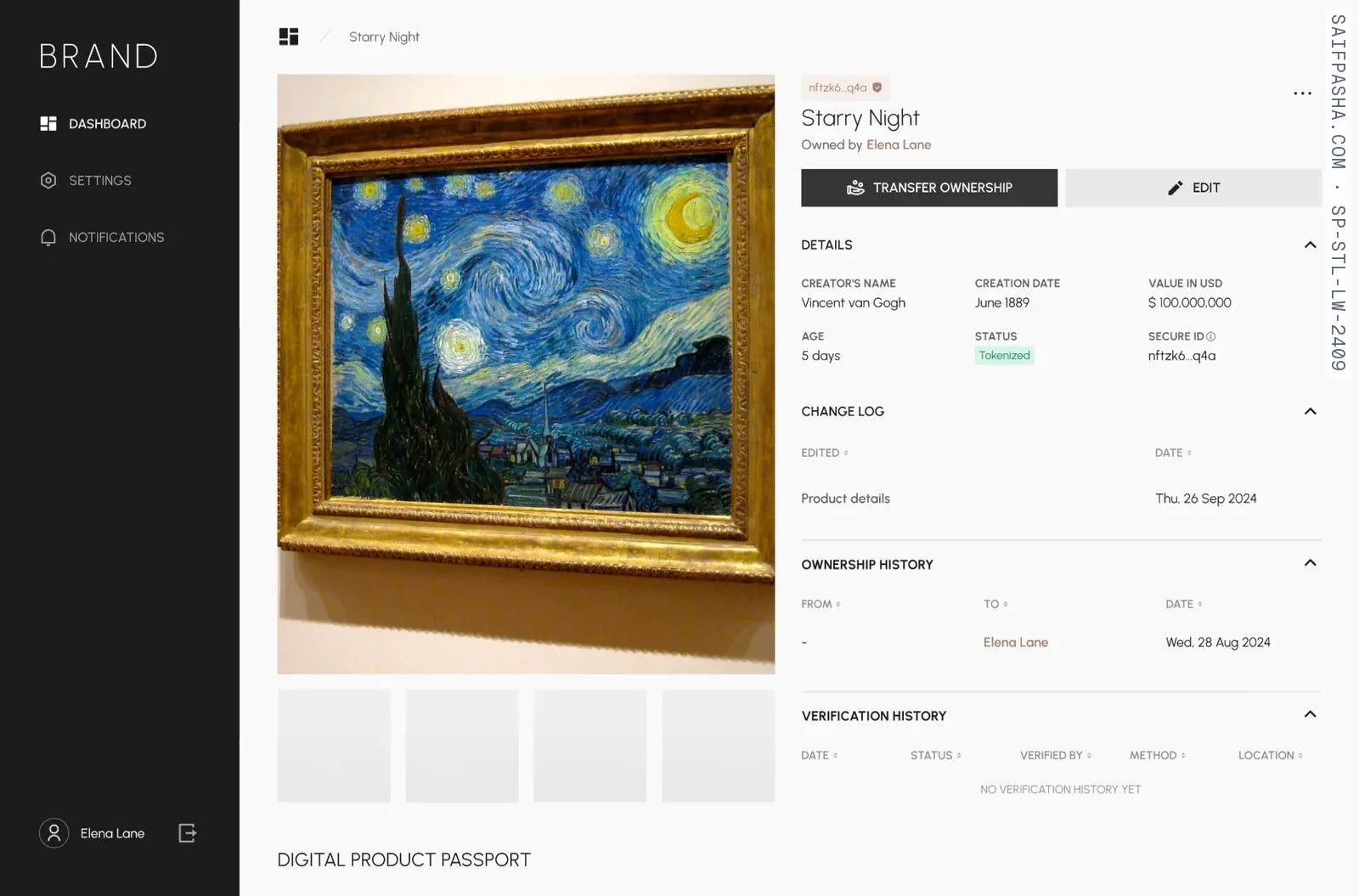
The screens went into the deck Chia carried into its meetings, where an owner sends a bag to a buyer one step at a time. After one of those meetings the person Chia had met took the designs to share with her wider team.
The first app
Chia asked next for a clickable prototype to show its board, on a date already set. A design tool can only pretend to scan something, so I talked Chia out of the prototype and built a real app instead, in React Native with Expo, so one codebase ran on iPhone and Android, with Supabase behind it for the accounts and the data.
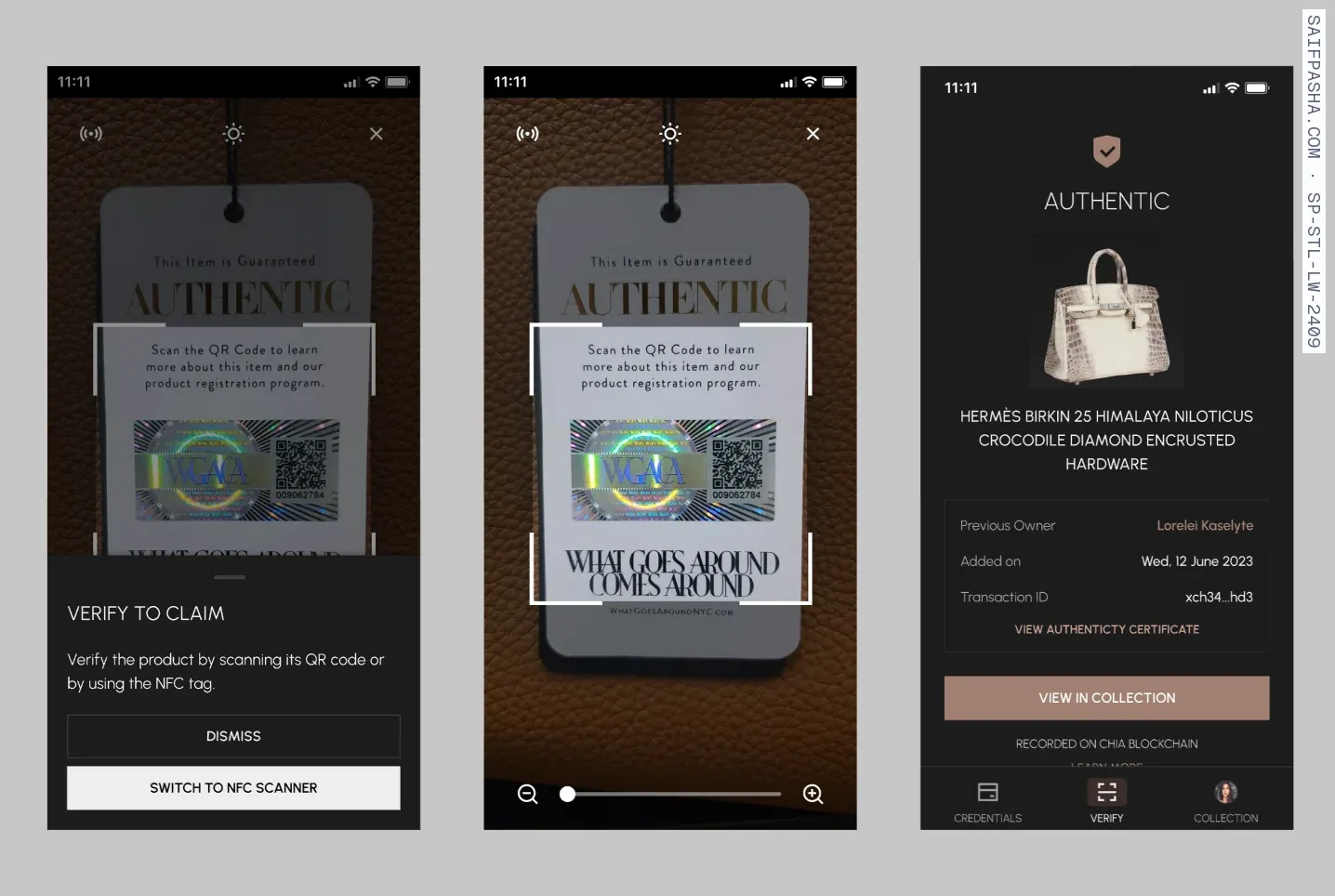
An owner picks a buyer and sends the product, and the buyer's phone shows the request the moment it's sent. The buyer accepts, then scans the product's tag to claim it, and only that product's tag completes the transfer. Any other tag gets a plain warning that the product isn't authentic. A seller's account opens in a light theme and a buyer's in a dark one, so a room watching two phones can tell at a glance who is who.
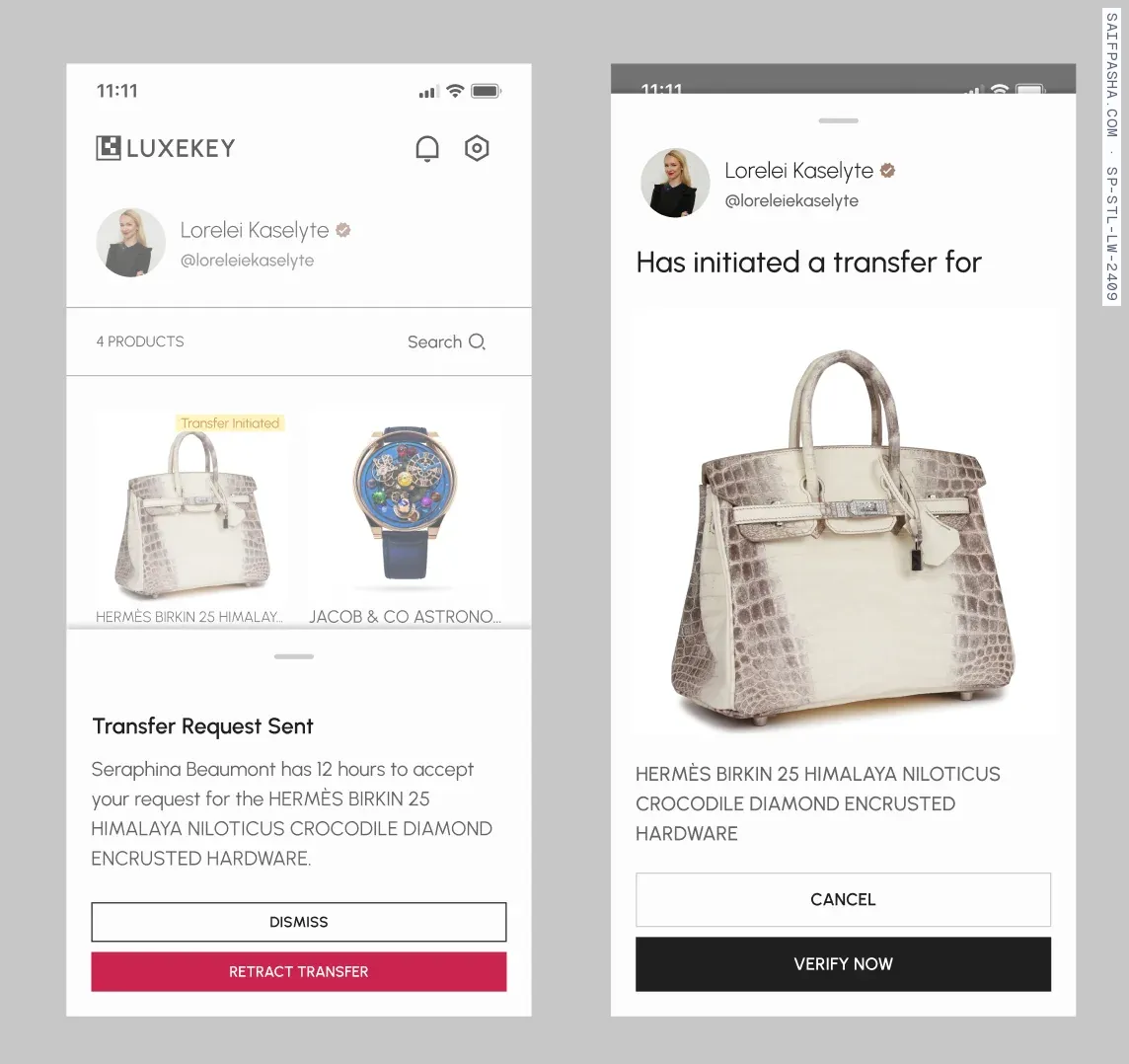
Apple's developer account was still weeks away, so the board saw the app on two iPhones through Expo Go, and the only thing that misbehaved on the day was the boardroom Wi-Fi. A phone hotspot sorted it about two hours before the demo. Chia bought a real luxury bag to show it on, and anyone could hold a phone up to its tag and watch its record appear.
How the first app worked
The problem: putting it on the chain
The first app kept its records in an ordinary database, which carried a board demo but not the idea, since the point was a record that nobody could quietly change. The next version had to mint every product on Chia's blockchain and move its ownership there. Chia's engineer on the project built the blockchain side, an API over Chia's wallet, and I built the dashboard and the app on top of it.
The chain made two demands. Chia's wallet syncs one key at a time, and how long that takes can't be predicted, so a transfer between two owners could stall in front of a room. And once a product is minted its details are fixed for good, which is what a record of authenticity should do, and awkward for a brand that spots a typo.
Chia's engineer moved the demo onto Chia's blockchain simulator, which keeps every wallet in sync on one machine, and my team set it up and built against it. For edits, the dashboard warns the brand, burns the old token and mints a new one with the corrected details, so the record of who made it stays with the brand.
How a product lives on Chia's blockchain
What I built
The dashboard I built is where a brand starts. It adds a product, fills in its passport, from what the product is made of to how it should be recycled and who has owned it, and tokenises it, which mints it on the chain. The same product then appears in its owner's app with its passport, its owners and every check made on it.
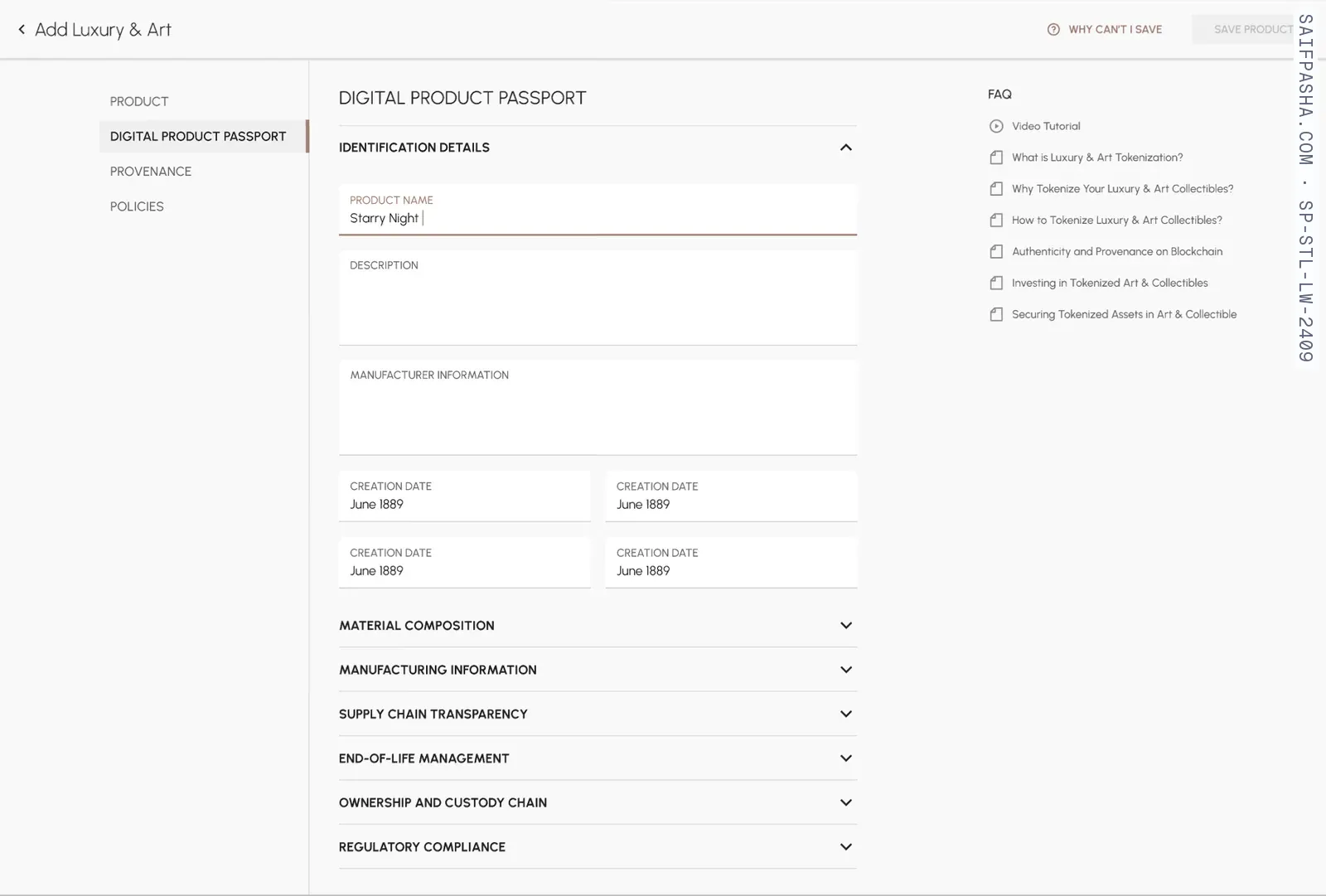
The dashboard took more than luxury goods. A brand could tokenise a letter of credit the same way it tokenised a bag, since Chia was making that case to banks too. For Chia's next board meeting, the COO asked for one recording that ran from tokenising a product through checking it and proving who owns it to handing it on, and I recorded and narrated it the night before.
A few months on, Chia was heading into luxury meetings and wanted the tag inside the product, read with a tap, in place of a printed code. My team moved the app off Expo so it could read NFC tags that carry nothing but the product's ID, then tested it against two real tags and one stranger. Chia's own engineers built the iPhone version for the trip and found the last bug, a product whose details held characters the transfer couldn't take.
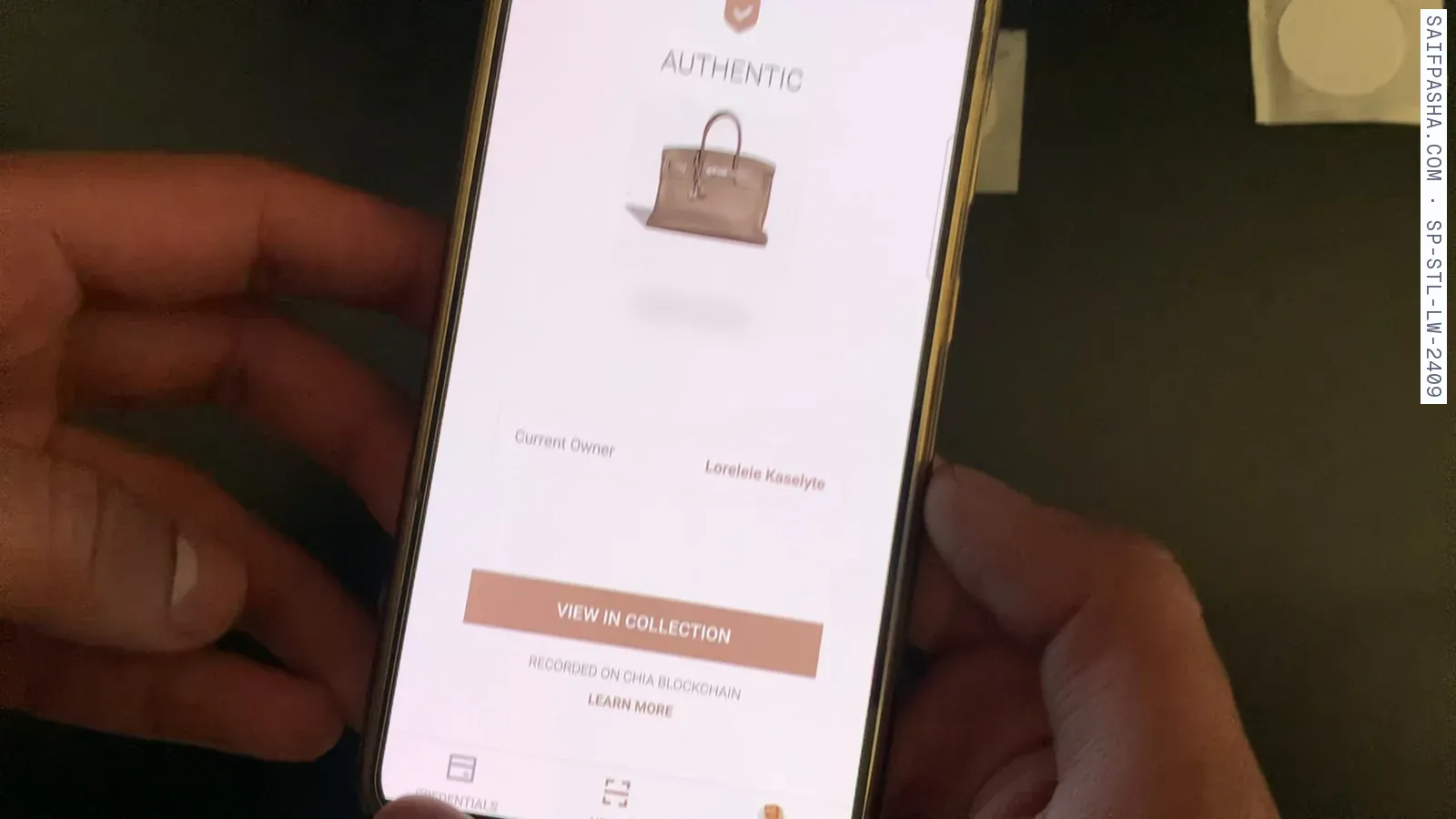
Moving from QR codes to NFC
The result
Chia's board saw Luxkey twice, and the second time the COO came back to say the meeting had gone really well. Chia demoed it to luxury houses, Chanel, Versace and Dior among them, and in February the COO took the NFC version into a week of luxury meetings and came home setting up follow-up meetings with two customers. Chia then moved the app's database into its own account so it could keep showing Luxkey on its own.
What Chia had at the end was what a slide couldn't give it, a luxury product that anyone could check and hand on with a tap of a phone, recorded on its own blockchain.
The board demo could not have gone better.
Written by Saif Pasha. Built with my team at Silverthread Labs. © 2026 Saif Pasha and Silverthread Labs. Ref. SP-STL-LW-2409
saif@silverthreadlabs.com