Blockchain game UI design and front-end development for Chia Network
Bram Cohen's team at Chia built a way for two people to play games of skill for real money, where only the first and last move touch the blockchain, and wanted it shown as games anyone could play. I designed California Poker and Krunk and art-directed Space Poker, and my team built the poker front end in Chia's own code.
- Client
- Chia Network
- Sector
- Blockchain gaming
- Scope
- Product DesignUX/UI DesignDesign SystemsFront-End Development
- Technologies
- FigmaReactTypeScriptWebAssemblyWalletConnect
Background
Bram Cohen started Chia after inventing BitTorrent, and he wanted two people to be able to play games of skill against each other for real money, in real time, with no casino in the middle and no way for whoever loses to skip out on paying. His team built it on state channels. Two players lock their stakes into one coin on Chia's blockchain, play as many hands as they like off the chain, with every move signed by both of them, and settle on the chain when they're done. Only the first step and the last ever touch the chain, unless one of them cheats or stops answering, and then the game is played out on chain, where its rules are enforced in code.
He wanted to show the idea as three games. California Poker deals each player eight cards face up, and each gives four of them away. Krunk is a word game in the style of Wordle, named Krunk for trademark reasons. Space Poker is hold'em without suits.
How a game runs on a state channel
The problem: making state channels playable
Chia's engineering lead told me Bram needed help with his UX and UI, and put me on a call with Bram and his lead engineer. What I was handed was one game, California Poker, on a bare HTML page with a few form controls over the Rust engine underneath. It was built to test the engine, not to be played, and you'd have learned more about the game from the command line or the source code. The other two games were still sketches.
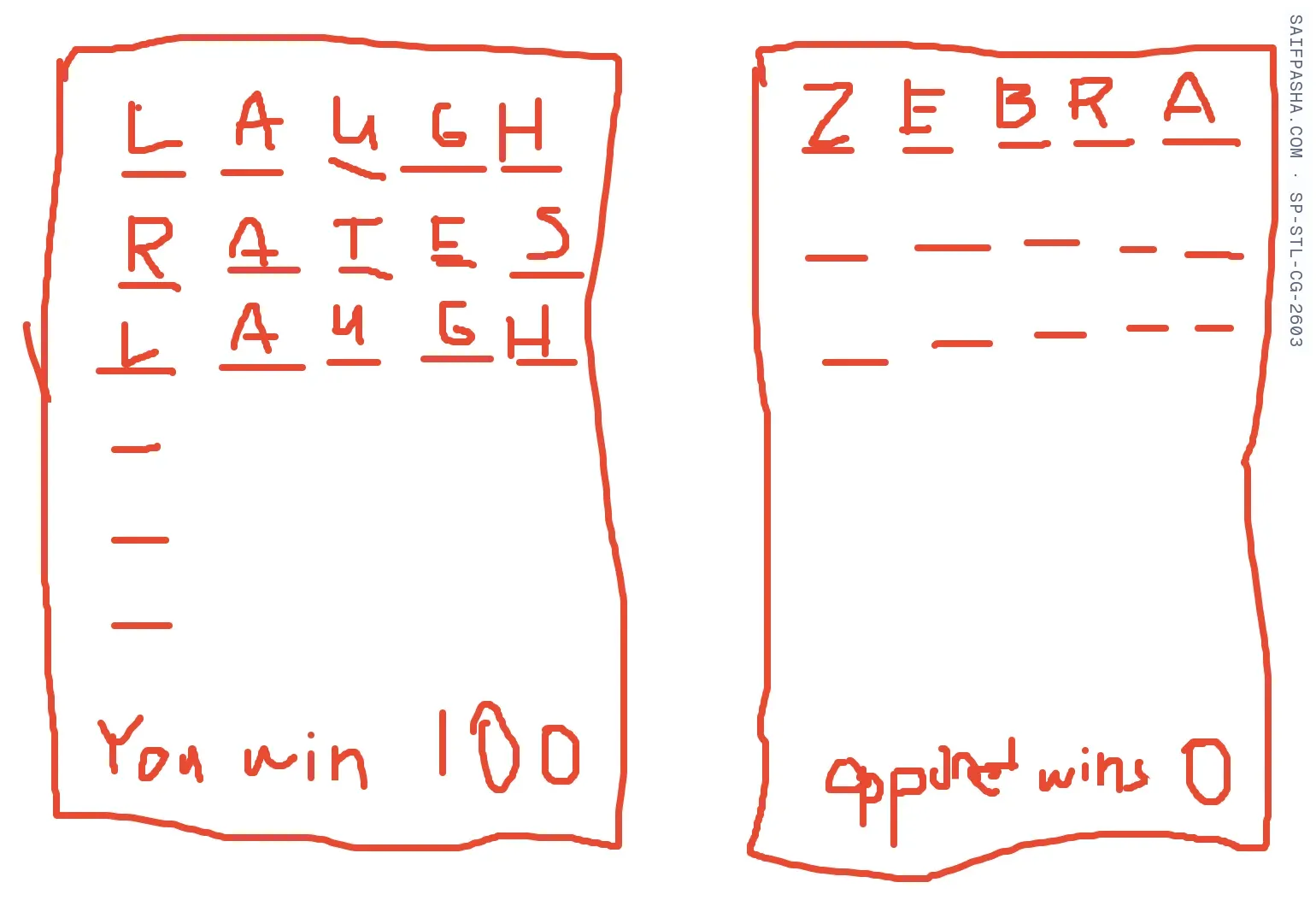
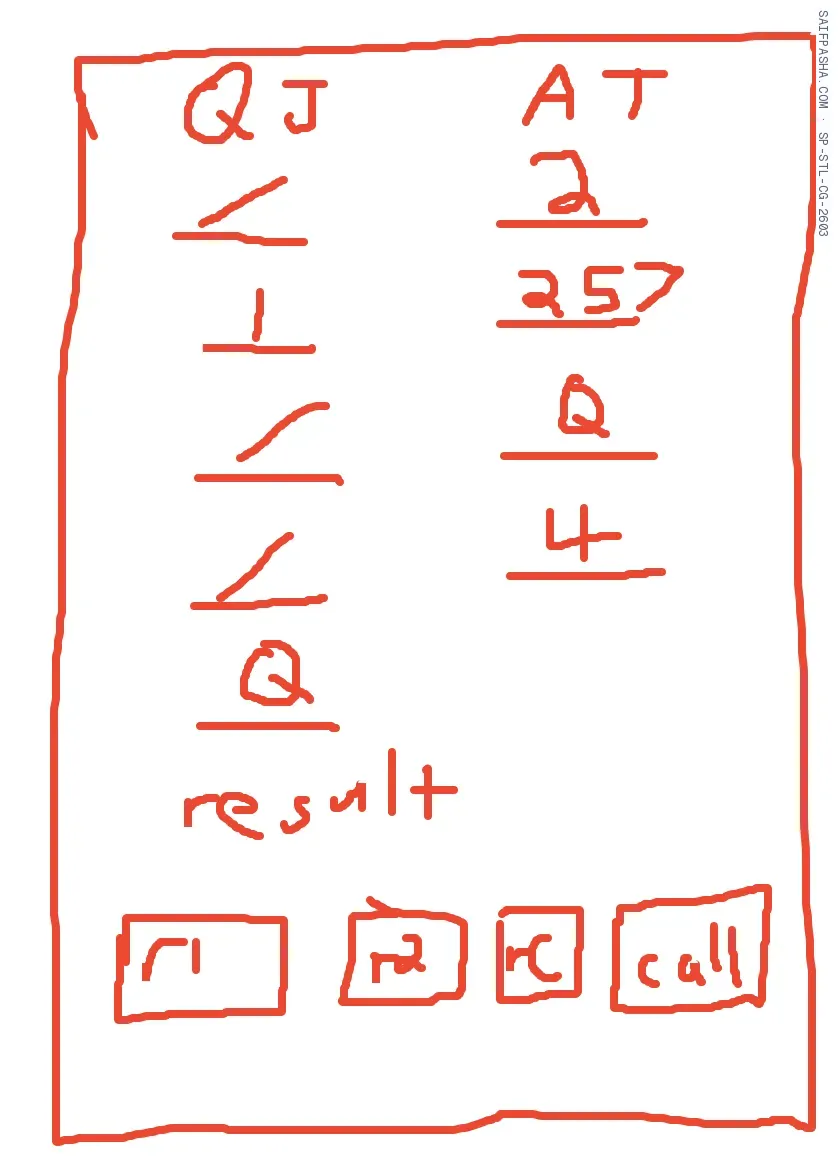
Bram had already written every game down, its rules, each step of its flow and every way it could end, down to the colour of each suit. What the games needed was a face a player could follow. A player only ever sees their own side, so the screen has to say whose turn it is and what they're about to give away, and once the hand is over, what they won. It also has to explain what no ordinary card game ever has to, such as a hand that ends because the other player ran out of balance or was caught cheating, and every one of those endings moves real money.
Bram wanted his own team to write the code, since he expected a lot of back and forth on the games and wanted to do it together. So my part was the design, one game at a time, starting with California Poker.
What I built
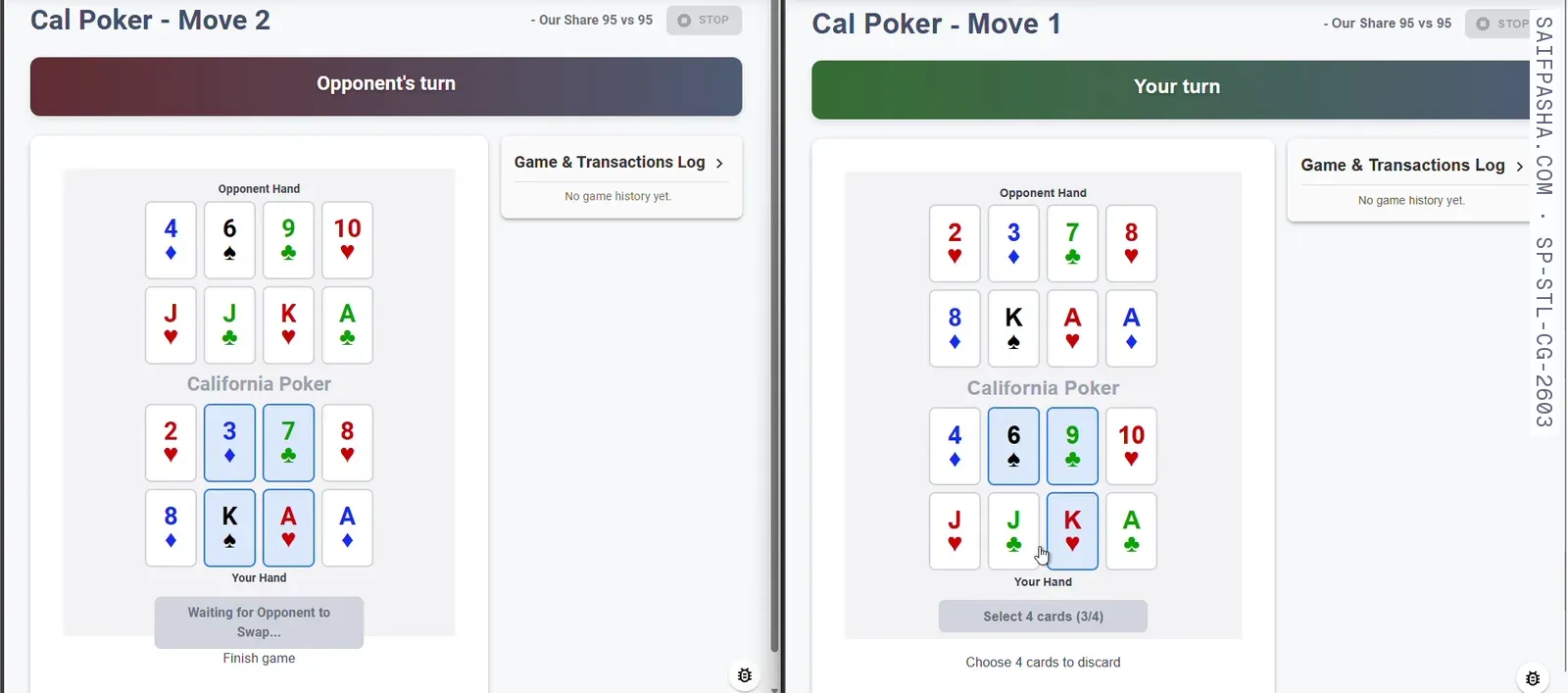
California Poker came first. I designed one player's view of the game, from the eight cards dealt face up, through picking the four to give away and waiting on the other player, to the swap and the result. Bram's lead engineer went through it first and Bram after him, both in comments on the Figma file, and every round went into the next version. Each player is told whether they won or lost rather than shown a player number, since Bram didn't want players to have an order or an identity in his games.
Bram expected card players to want their eight cards dealt in no particular order and moved into place by hand. I made the case for sorting them by rank, so a player can read the whole hand at a glance before choosing four to give away, and set the reasoning out beside the flows, and Chia's published rules for California Poker show the cards sorted by rank.
Once Bram signed California Poker off, he moved on to Krunk, and I designed it the same way, from choosing a word for the other player to guess, through each guess and its clue, to the result. A guess on the first or second try wins the whole amount, and the payout falls with every guess after that, so the screen shows what's at stake before the first guess. Bram signed that off too. Space Poker came after, and since it's poker too, it built on California Poker's design, with my art direction.
Designing California Poker and Krunk
The front end
Later, Chia had weeks of front-end work scoped on the games and its own front-end engineer was busy elsewhere, so it asked me for a developer. My team joined Bram's gaming team in Chia's own repository, working from Chia's tickets, and built California Poker into Chia's player app, from the lobby, where one player opens a room and sets the stakes and the other joins, through every move of the hand.
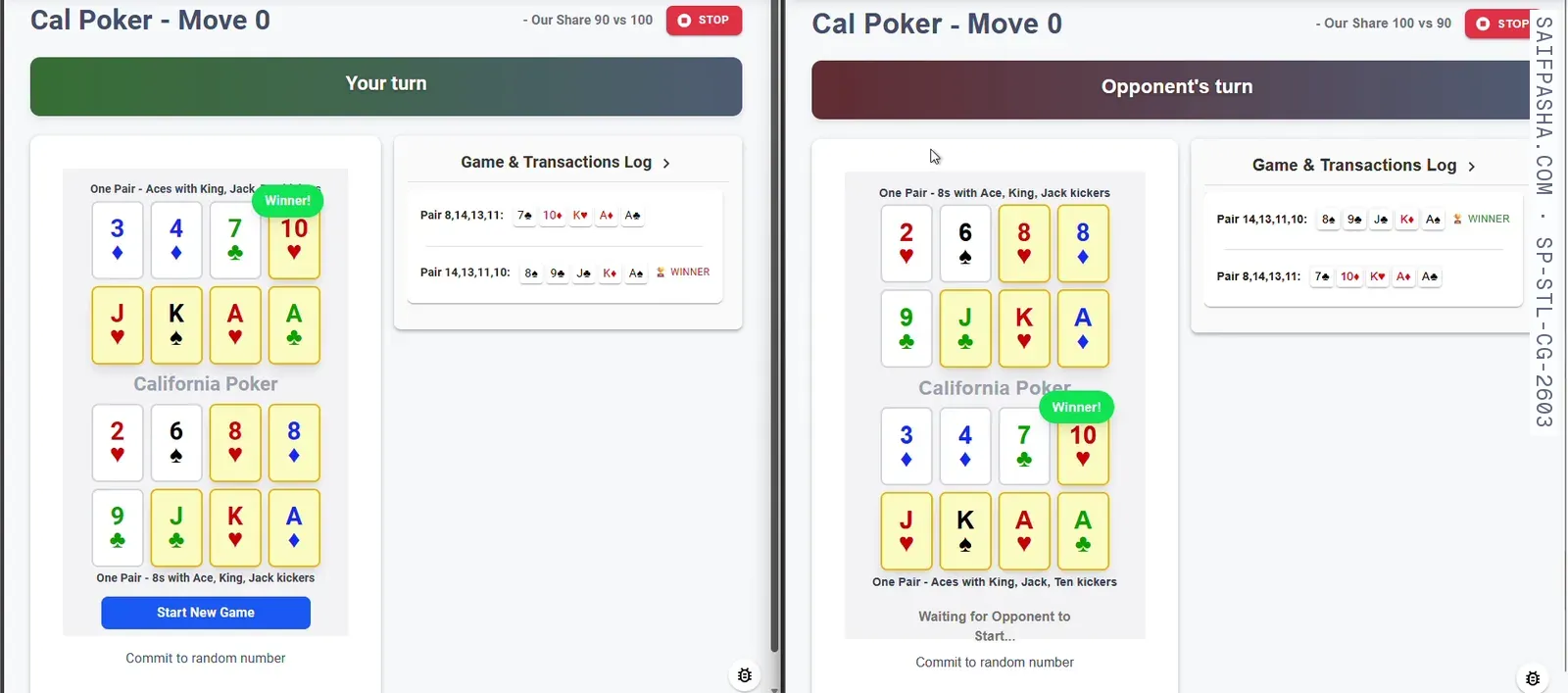
At the end of each hand the app finds the best five of each player's eight cards, lights them up and names the hand, and the log beside it keeps every hand of the session.
How the player app works
The result
When my team handed it over, California Poker ran in Chia's own player app from the lobby to the last hand, and both games I'd designed had Bram's sign-off. Bram had always wanted to shape the games with his own hands, and he carried the front end on from there to Chia Gaming's beta, which went out with all three games for partners to run.
Written by Saif Pasha. Built with my team at Silverthread Labs. © 2026 Saif Pasha and Silverthread Labs. Ref. SP-STL-CG-2603
saif@silverthreadlabs.com