Carbon registry dashboard and address book for Chia's Core Registry
The World Bank and the Kingdom of Bhutan, both clients of Chia Network, commissioned changes to Core Registry, the open-source software a country runs its carbon credit registry on, and Chia brought them to me. I designed a dashboard that puts a registry's numbers on its public website, and my team built it and an address book for issuing credits.
- Client
- Chia Network
- Sector
- Carbon markets
- Scope
- Product DesignWeb App DevelopmentData VisualizationBackend Development
- Technologies
- FigmaReactTypeScriptRedux ToolkitChart.jsTailwind CSSNode.jsSequelize
Background
Core Registry is Chia's open-source software for running a national carbon credit registry. A country records its carbon projects and credits in it, can turn those credits into tokens on Chia's blockchain, and publishes its records to the Climate Action Data Trust, the shared record of carbon credits that began as the World Bank's Climate Warehouse. Chia built it with the World Bank's Climate Warehouse team, and Bhutan, the first country to connect its national registry to that shared record, runs its registry on it.
Testing the system the World Bank had defined turned up what the countries running it would need next, and the World Bank and the Kingdom of Bhutan commissioned the work, which Chia brought to me. The biggest pieces were a dashboard that showed a registry at a glance, inside Core Registry and on the country's public website, and an address book, because issuing credits meant typing the recipient's wallet address by hand every time, which was daunting and easy to get wrong.
The problem: eight repositories
Core Registry is a family of apps. The registry and the tokenization engine each had a back end and an interface of their own. The token driver, which creates and destroys the tokens on the chain, also ran the explorer, which had an interface of its own, and two more repositories wrapped all of it into one API and one app. Just running it locally meant those eight repositories working together, on one version of Node for the JavaScript apps and one of Python for the token driver, all reading a single shared config file. Under them sat Chia itself, a node with its wallet and DataLayer synced to the test network Chia keeps for registries, and nothing would start until it was.
Chia's engineers walked my team and me through it on calls, and every commit had to be signed before they would merge it. It took weeks of calls and setup before my team changed a line.
What I built
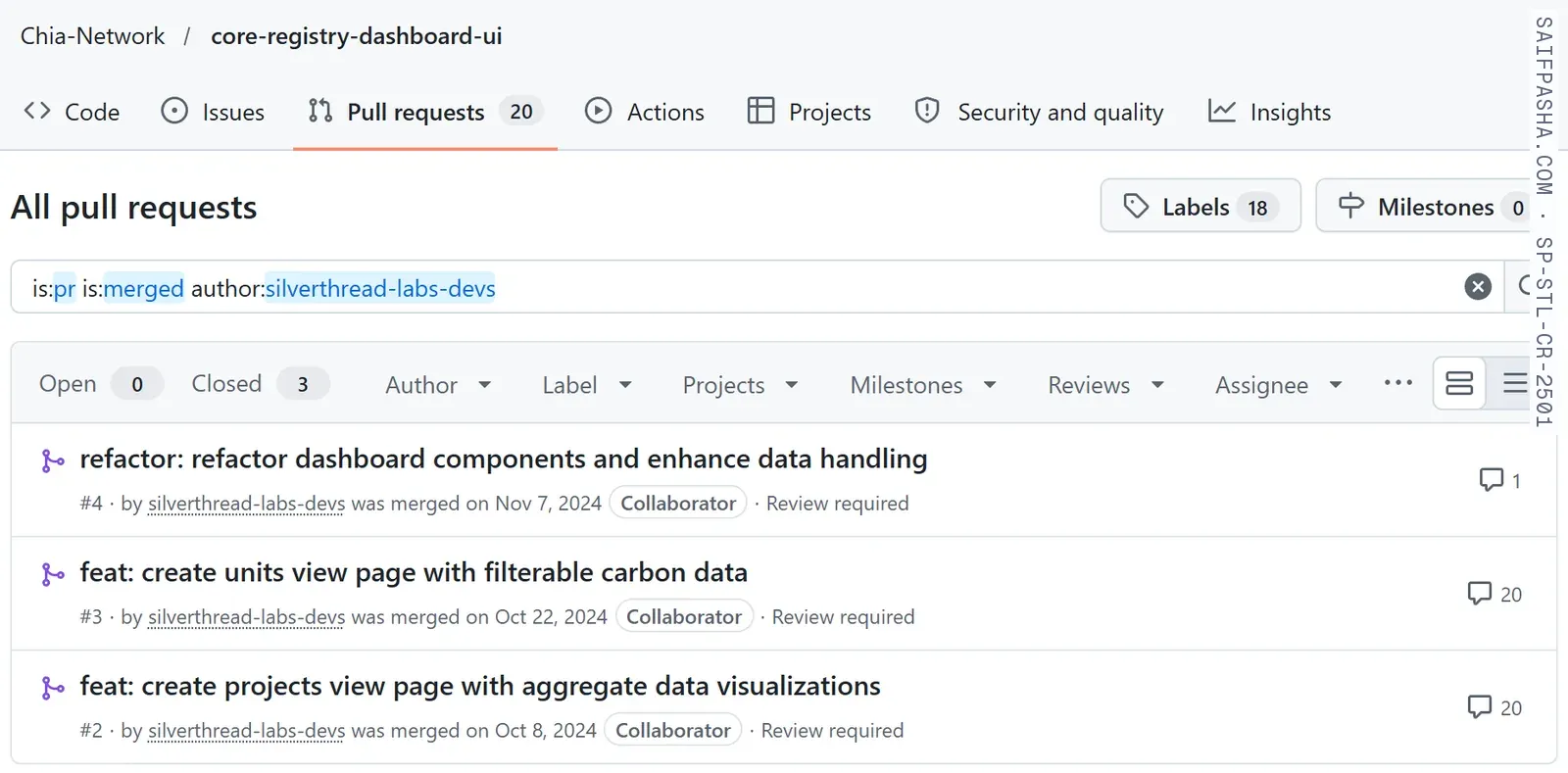
The dashboard was the heart of it, a new app beside the registry's own. Chia had sketched what it should show, and I designed it, first in Figma and then in code. Its first page counts the registry's projects by status, each status linking to the glossary that explains it, and breaks down the carbon issued by methodology and by project type, along with how many of the projects the registry hosts itself.
The second page shows ten years of issued carbon by type of unit, filtered by status, and every credit in the registry by status, filtered by vintage. The dashboard builds on its own as a web app, so a registry can put it on its public website, and Chia's engineers fitted it into Core Registry as its fourth app. Every label speaks the registry's own language.
How the dashboard works
The address book and its proxy
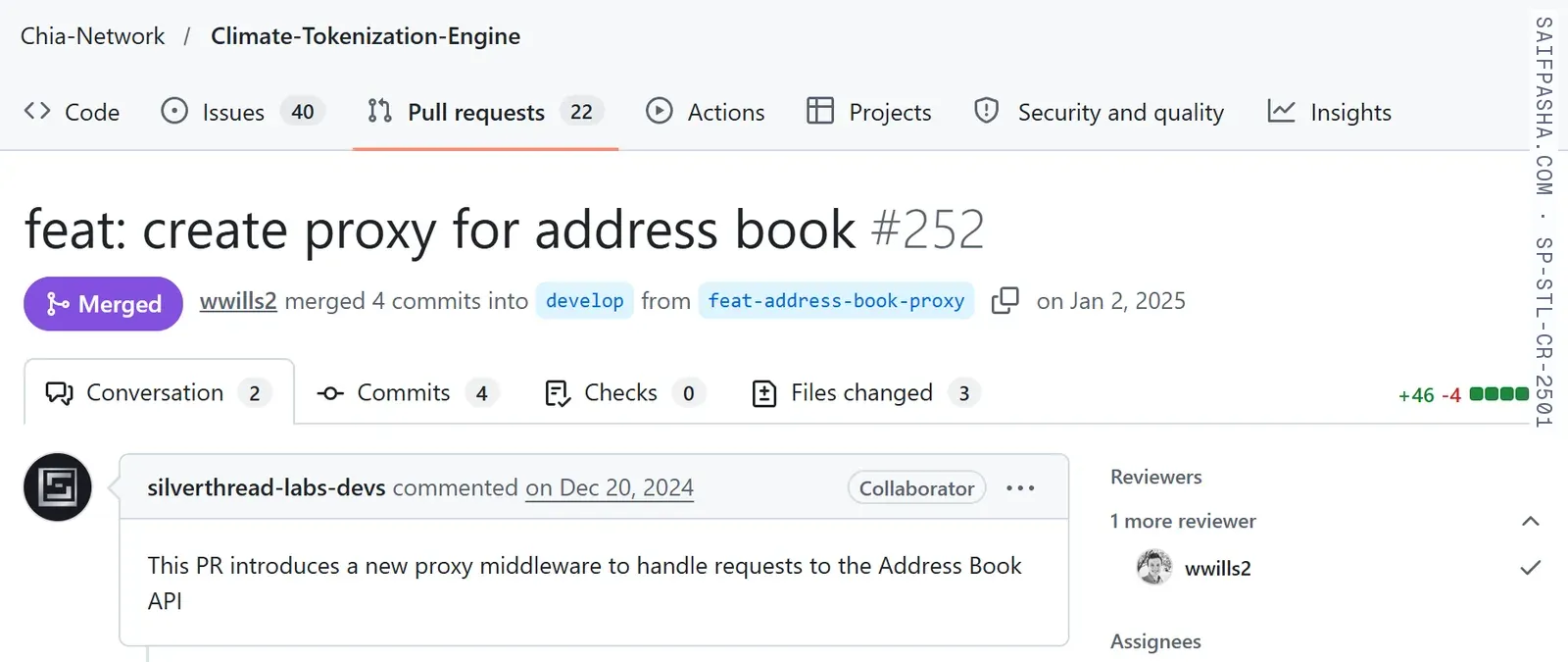
The address book took my team into the back end, and the hardest part of it was the proxy. The tokenization engine, where credits are issued, had no database of its own, but it never runs without the registry, so the address book lives in the registry's database, and the tokenization engine's interface only ever talks to the tokenization engine, which passes each request through. Who an issuer sends credits to isn't public, and a registry can also run a read-only copy of itself that anyone can query, so the proxy decides who gets through. It checks every request for the tokenization engine's own key, and only when that key is right does it add the registry's key from its config, on the server, where no browser ever sees it. Anything else is turned away before it reaches the registry at all.
For the issuer, it comes down to a list. They save each recipient's name and wallet address once, edit or delete them from the same page, and from then on pick the name from a dropdown when issuing credits, or paste an address as before.
How the address book works
The result
Every change went into Core Registry's own open-source code, reviewed and merged by Chia's engineers, and reached the World Bank and Bhutan through Chia. The dashboard shipped as the suite's fourth app. A country running Core Registry could now put its registry's numbers on its public website, and issue credits to a name it had checked once instead of a wallet address typed by hand.
Everyone at Chia owes you a beer, Saif. We hand you things with next to no instructions, and somehow you pull it off again.
Written by Saif Pasha. Built with my team at Silverthread Labs. © 2026 Saif Pasha and Silverthread Labs. Ref. SP-STL-CR-2501
saif@silverthreadlabs.com