White-label AI support chatbot builder for Aiden Solutions
An Australian founder was paying a great deal every month for people to answer the same support questions, and wanted every business to have a chatbot that already knew its own documents. My team and I built Aiden, which turns a business's manuals into a bot under its own brand, and within days of launch a 4x4 suspension maker put its dealers on it.
- Client
- Aiden Solutions
- Sector
- Customer support, Conversational AI
- Scope
- Product DesignSaaS DevelopmentAI Chatbot DevelopmentAI IntegrationVoice Interface
- Technologies
- FigmaNext.jsVercelSupabaseStripeVercel AI SDK
- Models
- gpt-5gpt-5-minitts-1
Background
Aiden began with a founder in Australia who runs a marketing agency and had been a client of mine for years. His business was paying a great deal every month for people to answer customers' questions, and most of the answers were already written down somewhere, in a manual, a catalogue or a policy. So he asked a simple question. Why shouldn't every business have a chatbot that already knows its own documents, one it can put on its own website so people get their answers there? I was on board the moment he said it.
The platform
Before my team designed a single screen, we spent the first weeks proving every feature could be built, because so much of how the interface would work depended on what the core could do. The design system came first and the screens came last. The first thing the founder saw wasn't a mockup but a short video of a bot answering from files it had just been given, and he showed it to his stakeholders that week.
A business signs up, uploads its manuals and catalogues, and builds a bot on them, with its own name, prompt, welcome message and error message.
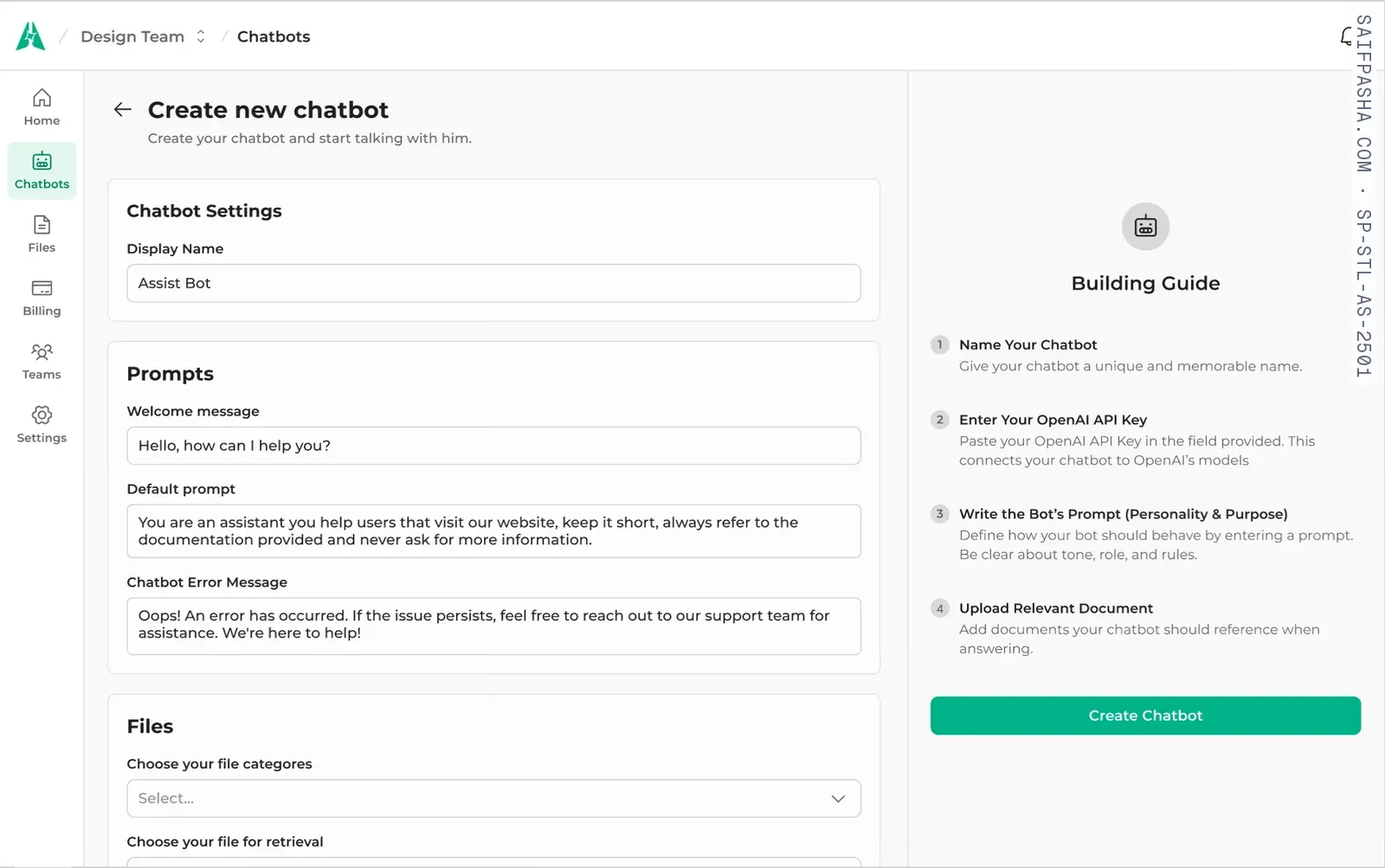
Then it gives the bot its own logo, colours and font, copies a few lines of code, and the bot sits on its own website, opening full-screen on a phone. Underneath, each bot is an assistant on OpenAI's Assistants API, searching that business's documents with file_search, so we never had to write our own chunking or embeddings.
Real use pushed back straight away. Supplier catalogues ran to 50 MB and wouldn't upload until the platform moved off the free tiers it had been tested on. The plans had been set up in US dollars when every customer would pay in Australian dollars. Stripe won't change a price once anyone has used it, so every plan was recreated and the app pointed at the new ones, the day before the first client signed.
How a bot is built and embedded
The problem: bots tied to one account
The hard part was the Assistants API itself. It was still in beta when we built on it, and it decided more than it showed. An assistant, its vector store and every file in it belong to the OpenAI project whose key created them. Each business could bring its own key, which kept the running costs with the business. It also meant a bot only answered to the key it was created under.
When the suspension maker's key was swapped for one from another project, every bot it had stopped answering at once, while new bots worked fine. Nothing was wrong with the old bots. The new key simply couldn't see them. The only fix was to rebuild them under the new key, which duplication made a single click. Later, OpenAI deprecated the Assistants API altogether, and we moved Aiden onto the Responses API.
Building on OpenAI's Assistants API
What I built
As more businesses signed on, the product grew with them. My team built teams, with owners, admins, editors and viewers invited by email, which was the most complex part of the whole build. A technician can now photograph a part or an error message and ask about it.
Voice came next. The founder had three options, from dictation to a fully hands-free conversation, and chose the one in the middle: a conversation on one button, where the bot listens, answers and reads its answer aloud. Bulk upload and duplication followed. Then came a way for a customer to drop their own document, such as a lease, into the chat and ask about it, without anyone changing what the bot knows.
Everything looks good to go, mate
Then Aiden was redesigned and rebranded. Anyone can try a bot on the public site without an account, the emails come from Aiden rather than the services underneath it, everything is written in Australian English, and the OpenAI key a business once had to bring is now Aiden's to manage.
What the chat can take
The result
Within days of going live, the founder signed his first client, a 4x4 suspension maker, which put its dealers on Aiden to answer from its own product documents. A founder who had been paying people to repeat what his documents already said had a product that answers from them, under each business's own brand. My team still keeps it running for him.
You're a star, mate! I appreciate the effort
Written by Saif Pasha. Built with my team at Silverthread Labs. © 2026 Saif Pasha and Silverthread Labs. Ref. SP-STL-AS-2501
saif@silverthreadlabs.com